
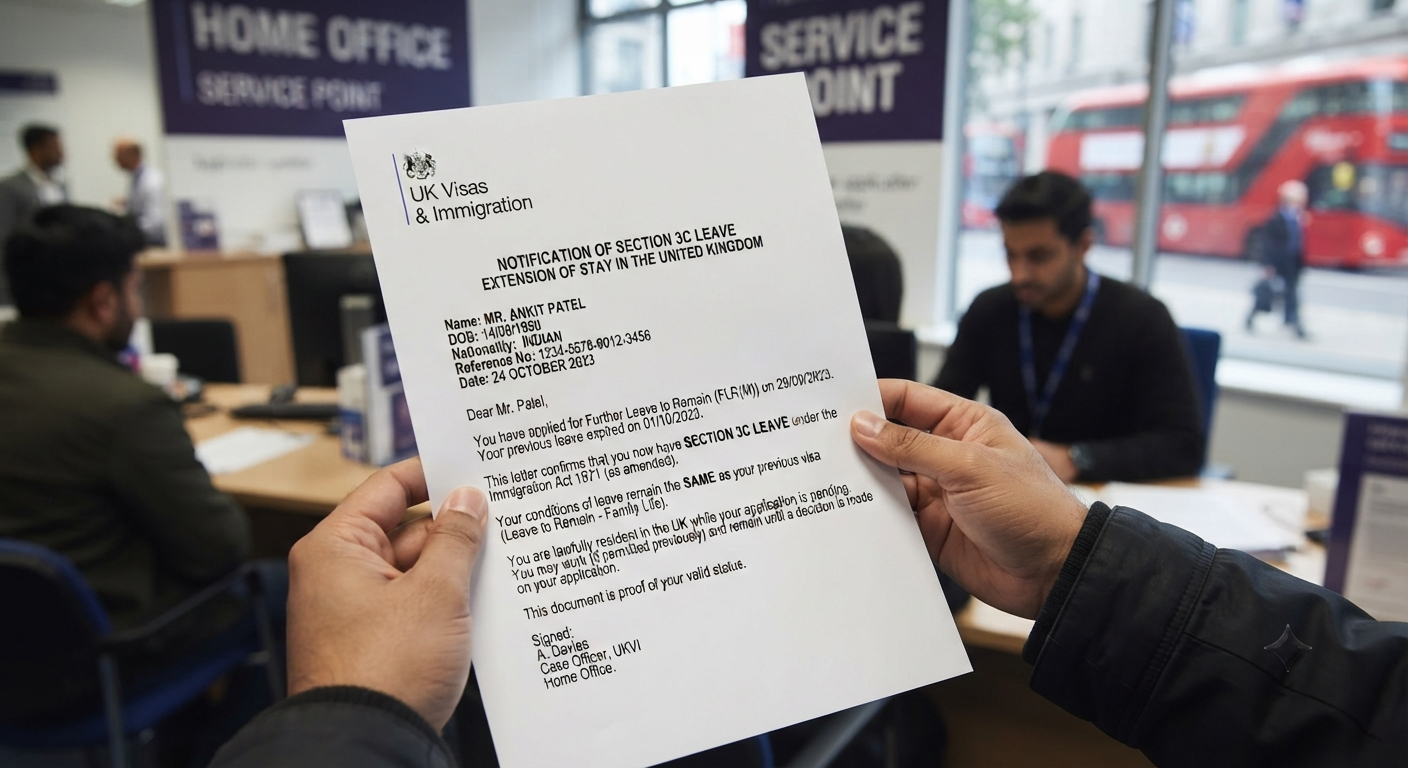
Section 3C Leave UK: Working After Visa Expiry in 2026
If your UK visa is about to expire while you are waiting for a decision on a new immigration application, you may be worried about whether you can legally remain in the UK and continue working.
This is where Section 3C leave can be extremely important.
Section 3C of the Immigration Act 1971 can extend your existing immigration permission when you make a valid, in-time application to extend or vary your leave before your current visa expires. If Section 3C applies, your previous immigration conditions generally continue while your application is being decided. This can include an existing right to work.
However, Section 3C leave does not automatically apply simply because you have submitted an application or because your visa has expired. There are specific requirements that must be satisfied.
This guide explains how Section 3C leave works in 2026, whether you can continue working after your visa expires, how to prove your right to work and what can happen if Section 3C leave ends.
Quick Summary
| Question | Answer |
|---|---|
| What is Section 3C leave? | A statutory extension of existing immigration leave in certain circumstances |
| Can it apply after your visa expires? | Yes, where the relevant requirements for Section 3C are met |
| Do you need to apply before your visa expires? | Generally yes — the application must be made in time |
| Can you continue working? | Usually, if your previous immigration permission allowed you to work |
| Do your previous work restrictions continue? | Yes |
| Can you start unrestricted work? | No — Section 3C normally carries forward your existing conditions |
| Can Section 3C apply to a late application? | Generally no |
| Can Section 3C continue during an appeal? | In qualifying cases, yes |
| Can Section 3C continue during an administrative review? | In qualifying cases, yes |
| Does leaving the UK affect Section 3C? | Yes. Section 3C leave ends when you leave the UK |
| Can Section 3C be cancelled? | Yes, in certain circumstances, including breaches of conditions |
What Is Section 3C Leave?
Section 3C leave is a legal mechanism designed to prevent a person who has made an in-time immigration application from becoming an overstayer while waiting for a decision.
The Home Office guidance explains that Section 3C is intended to prevent someone from becoming an overstayer while an application, appeal or administrative review is pending where the statutory requirements are satisfied.
For example:
Your current visa expires on 30 September 2026.
You submit an application to extend your permission on 20 September 2026.
If the application has not been decided by 30 September, Section 3C may extend your existing leave while the application is being considered.
This means the expiry date printed on your previous visa does not necessarily mean that you immediately become an overstayer.
Can You Continue Working After Your UK Visa Expires?
Yes, if Section 3C leave applies and your previous visa allowed you to work
This is one of the most important aspects of Section 3C leave.
When Section 3C applies, your existing immigration leave is generally extended on the same conditions unless those conditions are varied.
The Home Office specifically states that a person with Section 3C leave remains subject to the conditions attached to their previous leave. For example, someone who had permission to work may generally continue working under those conditions.
So, if your previous visa allowed you to work, your right to work can continue after the original visa expiry date while valid Section 3C leave is in force.
Example
Suppose you hold a Skilled Worker visa that expires on 30 September 2026.
You submit an eligible application to extend your immigration permission before 30 September.
Your application is still pending on 1 October.
If Section 3C applies, your previous permission and associated conditions can continue.
You may therefore be able to continue working under the conditions of your previous visa while the application is being decided.
Does Section 3C Give You a New Right to Work?
No.
This is an important distinction.
Section 3C generally extends your existing leave and its conditions. It does not simply give you a completely new and unrestricted immigration status.
For example, if your previous visa restricted the type of work you could perform, those restrictions can continue during Section 3C leave.
Therefore:
Previous visa allowed work → Section 3C may continue that permission.
But:
Previous visa did not allow work → Section 3C does not automatically create a new right to work.
Similarly, if your previous permission limited your work in some way, you should not assume that Section 3C removes those restrictions.
What Are the Requirements for Section 3C Leave?
Section 3C does not apply in every visa-expiry situation.
Generally, the following conditions are important:
- You have existing limited leave to enter or remain in the UK.
- You make an application to vary or extend that leave.
- You make the application before your existing leave expires.
- Your existing leave expires before the application is decided.
- The application has not been decided or withdrawn.
Where those conditions are satisfied, Section 3C can extend your leave.
What Does “In-Time Application” Mean?
An in-time application generally means an application made while you still have valid immigration permission.
In simple terms:
Visa expires: 30 September
Application submitted: 20 September
This is an application made before expiry and may be an in-time application.
But:
Visa expires: 30 September
Application submitted: 5 October
This is generally a late application and does not create Section 3C leave simply because an application has subsequently been submitted. The Home Office guidance expressly states that Section 3C does not extend leave where the application was made after the existing leave expired.
This distinction can be extremely important.
What Happens If You Apply on the Last Day?
An application made before your existing permission expires can potentially be an in-time application.
However, you should not deliberately wait until the last possible moment.
There can be problems involving:
- application validity
- payment
- identity requirements
- missing information
- technical problems
- incorrect application routes
- evidence
- biometric requirements
You should therefore aim to submit your application sufficiently before your visa expires.
The safest approach is to understand your immigration route and application requirements well before the expiry date.
What If Your Visa Has Already Expired?
This is where the situation becomes much more complicated.
If you did not make your application before your existing permission expired, you generally cannot rely on Section 3C simply because you later submitted an application.
The Home Office guidance states that Section 3C does not extend leave where the application was made after the current leave expired.
You may therefore have an overstaying issue and need specialist immigration advice.
Do not assume that submitting an application automatically puts you back into lawful status.
Can You Work While Your Application Is Pending?
If Section 3C leave applies and your previous immigration permission included a right to work, your existing work conditions can generally continue.
The Home Office’s right-to-work guidance confirms that where an in-time application has been made, existing rights — including a right to work — can continue while the application and any relevant appeal or administrative review are being determined.
This is particularly important for employees whose visa expires while their employer is waiting for confirmation of their immigration status.
How Do You Prove Your Right to Work?
Your employer still needs to conduct the appropriate right-to-work check.
If you have an outstanding in-time application and use the UK’s digital immigration system, your employer may be able to conduct an online right-to-work check using a share code.
The current Home Office guidance states that employers can use the online service for individuals with outstanding in-time applications and that the service can confirm the right to work where applicable.
Therefore, the fact that the expiry date on your previous visa has passed does not necessarily mean that you have lost your right to work.
The key question is whether you have valid Section 3C leave and whether your previous conditions permitted the particular work.
What If Your Employer Says Your Visa Has Expired?
This situation can happen when an employer sees an old visa expiry date and assumes that the employee can no longer work.
If you have made an in-time application, you should explain that you may have Section 3C leave.
Your employer should carry out the appropriate Home Office right-to-work check rather than relying solely on the expiry date printed on an old document.
For eVisa holders, the Home Office’s current guidance states that employers should use the online right-to-work service where appropriate for outstanding in-time applications.
If there is a problem with the online record, you may need to contact UKVI or obtain specialist advice.
Do Your Previous Work Restrictions Continue?
Yes.
Section 3C generally extends the conditions attached to your previous leave.
The Home Office gives the example that if someone had permission to work subject to a particular restriction, that restriction continues during Section 3C leave unless the Secretary of State varies the conditions.
For example, if your previous immigration permission only allowed certain employment, you should not assume that Section 3C lets you take any job you want.
This is particularly important for sponsored workers.
Can a Skilled Worker Continue Working for Their Sponsor?
Potentially, yes.
If you held a Skilled Worker visa and made an in-time application to extend or vary your permission, your existing work conditions can generally continue under Section 3C while the application is pending.
However, Section 3C does not automatically give you permission to change employer or start a different job that requires a change to your immigration conditions.
If you are changing employer or occupation in circumstances where an immigration application is required, you need to make sure you have the appropriate permission before starting the new work.
Can You Start a New Job While Your Application Is Pending?
This depends on the type of application and your existing immigration conditions.
Section 3C normally carries forward your existing conditions. Therefore, simply having Section 3C leave does not automatically mean you can start any new job.
For example, if your existing visa ties you to a particular employer, you should not assume that the extension of your existing leave allows you to immediately work for a completely different employer.
You should check the rules governing your particular route before changing jobs.
What Happens During an Appeal?
Section 3C leave can continue during a qualifying in-country appeal.
The Home Office guidance explains that Section 3C can continue during the period when an in-country appeal can be brought and while a properly pending appeal remains unresolved.
However, the exact position depends on how Section 3C arose and what happened to the original application.
You should not assume that simply having an appeal right automatically creates Section 3C leave.
What About Administrative Review?
Section 3C can also continue while a qualifying administrative review is pending.
The Home Office states that where a person already has Section 3C leave and has a right to administrative review, Section 3C can continue while the administrative review remains pending, subject to the relevant rules.
However, Section 3C can end in certain circumstances, including where a fresh application is made in circumstances that bring the administrative review to an end.
This is one reason why immigration applications should be handled carefully.
Can You Travel Outside the UK While on Section 3C Leave?
You need to be extremely careful.
The Home Office guidance states that Section 3C leave ends if the person leaves the UK.
This can have serious consequences for a pending application.
Before travelling internationally while your application is pending, you should obtain advice based on your specific immigration route and circumstances.
Do not assume that because your visa application is pending you can leave the UK and return without affecting your immigration position.
Can Section 3C Leave Be Cancelled?
Yes.
Section 3C leave is not an unconditional protection.
The Home Office has a power to cancel Section 3C leave in certain circumstances, including where a person has failed to comply with conditions attached to their immigration leave.
Examples can include:
- working outside permitted conditions
- breaching work restrictions
- failing to comply with other immigration conditions
- certain forms of deception
- other circumstances in which cancellation powers are applicable
If Section 3C leave is cancelled, the consequences can be serious.
For example, cancellation can mean that the person no longer has the previous right to work or other conditions associated with Section 3C leave.
Does a Visa Refusal Automatically End Section 3C?
A refusal of an application does not mean that every case is identical.
Where an application is refused, the next steps can depend on whether there is an appeal or administrative review and whether Section 3C remains in force.
The Home Office guidance also makes clear that Section 3C should not simply be cancelled solely because an application is being refused. Specific considerations apply where cancellation is being considered because of a breach of conditions or deception.
This is an area where professional immigration advice can be particularly valuable.
What Happens If Your Application Is Approved?
If your application is successful, you will normally receive your new immigration permission.
Your new permission then becomes the basis for your immigration status and right to work.
You should check your new immigration status carefully, particularly if you have an eVisa.
Check:
- name
- date of birth
- nationality
- visa route
- expiry date
- work conditions
- employer restrictions
- other conditions
If something appears to be incorrect, it should be addressed promptly.
What If Your Application Is Refused?
If your application is refused, do not simply continue working as though nothing has happened.
You need to understand:
- when your Section 3C leave ends
- whether you have an appeal right
- whether administrative review is available
- whether another application is possible
- whether you can continue working
- whether you need to leave the UK
The answer can depend heavily on the immigration route and the wording of the Home Office decision.
Section 3C Leave and Right to Work: Example
Consider this example.
Amir’s visa expires on 10 October 2026.
He submits an eligible application on 25 September 2026.
His application remains undecided on 11 October.
Because he made the application before his existing leave expired, Section 3C may extend his existing leave.
If his previous visa allowed him to work, his existing right to work may continue while the application is pending.
His employer can use the appropriate Home Office right-to-work process to verify his position.
Now consider a different situation.
Amir’s visa expires on 10 October.
He does nothing until 20 October and then submits an application.
He cannot simply rely on Section 3C to say that his previous visa continued after 10 October because the application was made after his leave expired.
The distinction between the two scenarios is critical.
Section 3C Leave vs Overstaying
These concepts should not be confused.
Section 3C leave
You made the relevant application before your existing permission expired and the statutory requirements for Section 3C are satisfied.
Overstaying
You remain in the UK after your immigration permission has ended without valid leave.
Someone whose visa appears to have expired on their document may still have lawful status if Section 3C applies.
Conversely, someone who has submitted an application may not necessarily have Section 3C leave if the application was made too late or other requirements are not met.
Common Mistakes to Avoid
1. Waiting until after visa expiry
This can prevent Section 3C from arising.
2. Assuming any application triggers Section 3C
The application must satisfy the relevant requirements.
3. Assuming Section 3C gives unrestricted work rights
It generally carries forward existing conditions.
4. Starting a new job without checking your conditions
Your existing immigration conditions may restrict the work you can perform.
5. Travelling without understanding the consequences
Leaving the UK can bring Section 3C leave to an end.
6. Ignoring an employer’s right-to-work concerns
If your employer cannot verify your status, resolve the issue promptly.
7. Assuming a pending application guarantees your status
A pending application and Section 3C leave are related but are not necessarily identical concepts.
8. Ignoring a refusal
If your application is refused, immediately check whether you have an appeal or administrative review option and what happens to your immigration status.
Section 3C Leave Checklist
If your UK visa is approaching expiry, consider the following:
Before your visa expires
- Check your visa expiry date.
- Identify the correct immigration route.
- Prepare your supporting documents.
- Check whether you need a new Certificate of Sponsorship.
- Submit your application before your existing permission expires.
- Keep confirmation of submission.
- Keep payment evidence.
- Complete any required identity or biometric steps.
- Check your right-to-work evidence.
After your visa expires
- Do not panic solely because the old expiry date has passed.
- Confirm whether Section 3C leave applies.
- Continue working only within your existing conditions.
- Keep evidence of your pending application.
- Respond promptly to Home Office requests.
- Avoid international travel without checking the consequences.
- Monitor your application.
- Obtain legal advice if there is a refusal, cancellation issue or dispute over your right to work.
What Employers Should Know About Section 3C
Section 3C is also important for employers.
An employer should not automatically assume that a worker has lost their right to work simply because the expiry date shown on an old immigration document has passed.
The Home Office’s 2026 right-to-work guidance explains that an in-time application can extend existing rights, including the right to work, while the application and relevant appeal or administrative review are pending.
For eVisa holders with outstanding in-time applications, the employer may use the Home Office online service and the worker’s share code where applicable.
Employers should therefore follow the prescribed right-to-work checking process rather than making assumptions based solely on an old visa expiry date.
What Evidence Should You Keep?
It is sensible to retain evidence showing that your application was submitted in time.
This can include:
- application confirmation
- submission date
- payment confirmation
- application reference
- Home Office correspondence
- biometric appointment evidence, where relevant
- emails relating to the application
- share-code information
- right-to-work check evidence
- copies of your previous immigration documents
These records can become particularly useful if there is a disagreement about your immigration status or right to work.
Can Section 3C Help With Settlement?
Section 3C can preserve lawful immigration status while a qualifying application is pending, but whether the period counts toward a particular settlement route depends on the applicable immigration rules.
You should not assume that every period spent under Section 3C automatically counts toward every ILR route.
If settlement is an important objective, your entire immigration history should be reviewed against the rules for the settlement route you intend to use.
What Should You Do If You Are Unsure Whether Section 3C Applies?
If your visa has expired and you are unsure whether you have Section 3C leave, take the issue seriously.
You should establish:
- When your previous immigration permission expired.
- When you submitted your application.
- Which immigration route you applied under.
- Whether the application was valid.
- Whether the application remains pending.
- Whether there has been a refusal.
- Whether you have an appeal or administrative review.
- Whether you have travelled outside the UK.
- What work conditions applied to your previous visa.
- Whether those conditions remain applicable.
A mistake about Section 3C can affect your immigration status and right to work.
When Should You Speak to an Immigration Solicitor?
Professional advice can be particularly useful if:
- you submitted your application after your visa expired
- your employer says you cannot work
- your employer cannot verify your right to work
- your application has been refused
- your Section 3C leave has been cancelled
- you have breached an immigration condition
- you travelled outside the UK while your application was pending
- you want to change employer
- your new job has different immigration requirements
- you have an appeal or administrative review
- you are concerned about overstaying
- your immigration status affects an upcoming ILR application
The earlier the problem is identified, the more options may be available.
Frequently Asked Questions
Can I work after my UK visa expires under Section 3C?
Potentially yes. If Section 3C leave applies and your previous immigration permission allowed you to work, your existing right to work can generally continue while the relevant application is pending.
What is Section 3C leave in the UK?
Section 3C leave is a statutory extension of existing immigration leave that can apply when a person makes an in-time application to extend or vary their permission and the relevant requirements are satisfied.
Does Section 3C automatically give me a right to work?
No. Section 3C generally extends your existing leave and conditions. If your previous permission allowed you to work, that right may continue, but Section 3C does not automatically create unrestricted work permission.
What happens if I apply after my visa expires?
Generally, Section 3C will not arise from an application made after your existing leave has expired. You may therefore have an overstaying issue and should obtain immigration advice promptly.
Can I change jobs while on Section 3C leave?
Not necessarily. Section 3C generally carries forward your previous immigration conditions. If changing employer requires new immigration permission, you need to follow the relevant rules before starting the new role.
Can I travel while on Section 3C leave?
You should be very careful. The Home Office guidance states that Section 3C leave ends when a person leaves the UK.
Can Section 3C leave be cancelled?
Yes. Section 3C can be cancelled in certain circumstances, including relevant breaches of the conditions attached to your leave.
How can my employer check my right to work during Section 3C leave?
For eligible cases involving outstanding in-time applications, the Home Office online right-to-work service can be used. For eVisa holders, the employer may use a share code to conduct the appropriate check.
Does a pending visa application always mean I have Section 3C leave?
No. The application must satisfy the requirements for Section 3C. For example, an application made after existing leave has expired does not create Section 3C leave simply because it is pending.
Final Thoughts
Section 3C leave can be an important protection for people whose UK visa expires while an in-time immigration application is still being considered.
Where Section 3C applies, your existing immigration leave can be extended and your previous conditions can continue. This can include an existing right to work.
But Section 3C is not an automatic extension available to everyone whose visa has expired.
The timing of your application is crucial. You generally need to have applied before your existing immigration permission expired. You also need to understand the conditions attached to your previous leave, because Section 3C normally carries those conditions forward.
If your application was late, your employer is questioning your right to work, you have received a refusal, you have travelled while your application was pending or you are unsure whether Section 3C applies, specialist immigration advice can help you understand your position.


