
Commercial Mediation vs Litigation UK: Costs & Time 2026
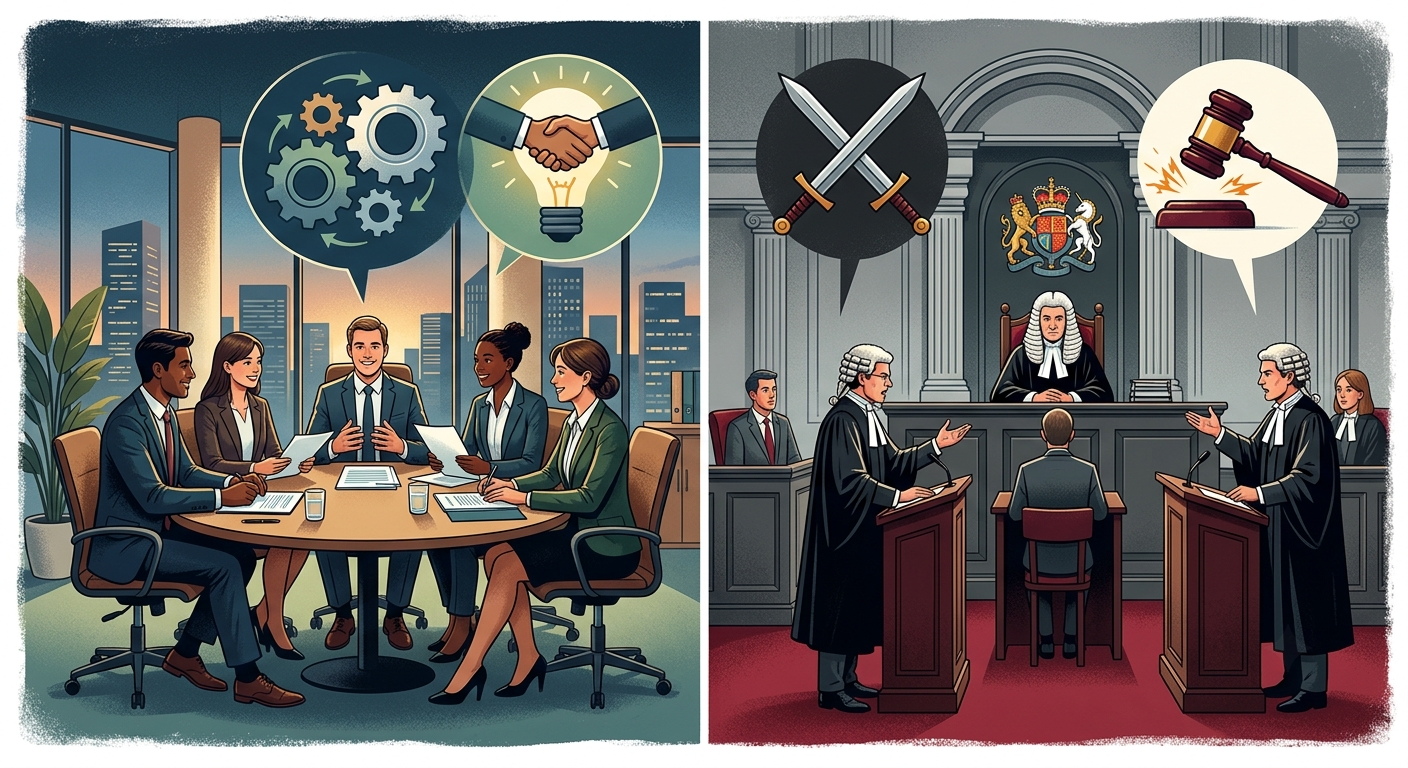
Commercial mediation allows businesses to negotiate a settlement with the assistance of an independent mediator. Litigation, by contrast, involves bringing a dispute before a court, where a judge determines the issues if the parties cannot reach an agreement. Mediation may resolve a dispute without a trial, while litigation provides a formal legal process for determining rights and remedies.
In 2026, businesses considering commercial dispute resolution in the UK should understand the practical differences between mediation and court proceedings. The best option depends on the value of the claim, the strength of the evidence, the urgency of the dispute, the willingness of the parties to negotiate and whether a binding court judgment or urgent court order is needed.
This guide explains commercial mediation vs litigation in the UK, including costs, timelines, confidentiality, legal risks, settlement agreements and the circumstances in which each approach may be suitable.
Quick Summary: Commercial Mediation vs Litigation UK
| Factor | Commercial mediation | Litigation |
|---|---|---|
| Purpose | Helps parties negotiate an agreed settlement with an independent mediator. | Uses court proceedings to determine legal disputes and remedies. |
| Costs | Usually involves mediator fees, preparation costs and any legal representation chosen by the parties. | Can involve court fees, solicitor fees, barrister fees, expert evidence and other litigation expenses. |
| Time | A mediation meeting may take hours or a day, although preparation and negotiations can take longer. | Timelines vary. Complex commercial cases can take many months or longer to reach trial. |
| Decision maker | The parties decide whether to accept a settlement. | A judge decides the issues that remain unresolved at trial. |
| Confidentiality | Generally conducted on a confidential and without prejudice basis, subject to legal exceptions and the parties’ arrangements. | Court hearings and judgments are generally subject to public access rules, although exceptions apply. |
| Outcome | A settlement can be recorded in a written agreement and may be made into a court order where appropriate. | A judgment or court order can determine rights and may be enforced through legal procedures. |
| Control | Parties retain control over whether and on what terms they settle. | The court controls the proceedings and determines contested issues. |
| Best suited for | Disputes where negotiation may produce a practical agreement. | Disputes requiring a binding judicial determination, urgent remedies or a decision despite disagreement. |
Key Takeaways
- Commercial mediation and litigation are different methods of resolving business disputes, and neither is automatically the right choice for every case.
- Mediation can reduce overall dispute costs and help parties settle more quickly, but settlement is not guaranteed.
- Commercial litigation may be necessary when a business needs a court judgment, urgent relief or a decision on disputed legal rights.
- UK civil procedure encourages parties to consider appropriate forms of alternative dispute resolution, including mediation.
- Courts may take unreasonable failure to engage with alternative dispute resolution into account when dealing with costs.
- A mediation settlement should be documented carefully. If court proceedings have already started, a consent order or Tomlin order may be appropriate in suitable cases.
- Businesses should compare the likely cost of mediation with the potential cost, duration and risks of continuing litigation.
What Is Commercial Mediation in the UK?
Commercial mediation is a form of alternative dispute resolution in which an independent mediator helps businesses or other parties attempt to resolve a dispute through negotiation.
The mediator does not normally decide who wins the case. Instead, they facilitate communication, help identify the issues in dispute and support discussions about possible settlement terms.
Commercial mediation may be suitable for disputes involving:
- Breach of commercial contracts.
- Unpaid invoices and outstanding business debts.
- Supplier and distribution agreements.
- Shareholder and partnership disagreements.
- Professional negligence claims.
- Intellectual property and licensing disputes.
- Construction and project disagreements.
- Business sale and purchase disputes.
- Commercial property and landlord disputes.
Mediation can take place before court proceedings begin or after a claim has been issued. The parties may choose an independent mediator, agree on a suitable format and decide whether legal representatives will attend.
A mediator’s role is different from that of a solicitor. The mediator facilitates the negotiation but does not normally act as either party’s legal adviser.
How Does Commercial Mediation Work?
The process varies depending on the dispute, the mediator and the parties’ arrangements. A typical mediation may involve the following stages:
- Choosing a mediator: The parties agree on an independent mediator with suitable experience.
- Agreeing the arrangements: The parties confirm the date, format, fees and any procedural requirements.
- Preparing documents: Each side identifies the key issues, supporting evidence and desired outcomes.
- Opening discussions: The mediator explains the process and may invite each side to summarise its position.
- Negotiating privately: The mediator may speak to each party separately to explore possible solutions.
- Considering settlement options: The parties assess potential terms, risks and commercial consequences.
- Recording the agreement: If settlement is reached, the terms are documented appropriately.
Some commercial mediations are conducted online, while others take place in person. The parties may remain in separate rooms throughout the process if that arrangement is agreed.
What Is Commercial Litigation in the UK?
Commercial litigation is the formal process of resolving a business dispute through court proceedings. It is commonly used when negotiations have failed, a party disputes liability or a business requires a court to determine its legal rights.
Depending on the dispute and the applicable rules, a commercial claim may be brought in the County Court or the High Court, including the Business and Property Courts where appropriate.
Commercial litigation can involve:
- Issuing a claim and serving the necessary documents.
- Preparing statements of case setting out the parties’ positions.
- Exchanging relevant documents and evidence.
- Preparing witness statements.
- Obtaining expert evidence where permitted and necessary.
- Attending case management hearings and complying with court directions.
- Negotiating settlement during the proceedings.
- Proceeding to trial if the dispute remains unresolved.
Litigation can be valuable when a business needs a formal determination of disputed rights. However, the process may require significant preparation, legal expenditure and management time.
What Can a Court Decide?
Depending on the legal basis of the claim and the court’s powers, a court may decide whether a party breached a contract, determine liability, assess damages or make other appropriate orders.
The available remedies depend on the nature of the dispute, the evidence, the applicable law and the relief requested.
A court judgment may also provide a formal basis for enforcement if the unsuccessful party does not comply voluntarily.
Commercial Mediation vs Litigation Costs in the UK
Cost is often one of the main considerations when businesses compare mediation with litigation.
Commercial mediation may be less expensive because it can avoid or shorten lengthy court proceedings. However, it still involves costs, including mediator fees, preparation time and any legal advice or representation used by the parties.
Litigation costs can be substantially higher in complex cases because legal teams may need to prepare extensive documents, manage disclosure, instruct experts and attend multiple hearings.
There is no single cost that applies to every commercial mediation or litigation case. Fees vary according to the dispute’s value, complexity, location, legal representation and the amount of work required.
Commercial Mediation Costs
The main costs of commercial mediation may include:
- Mediator fees: The mediator may charge an hourly rate, a fixed fee or a fee based on the duration and complexity of the mediation.
- Legal advice: Businesses may pay solicitors or barristers to assess the case and advise on settlement terms.
- Preparation: Staff and advisers may need to prepare a position statement, chronology and relevant documents.
- Attendance: Employees, directors and legal representatives may spend time attending the mediation.
- Follow-up work: A settlement may require drafting, approvals, payment arrangements or implementation steps.
The parties commonly agree how mediator fees will be shared. Equal sharing is common, but the arrangement should be confirmed in advance.
Before booking a mediation, businesses should request a clear fee estimate and check whether the quoted amount includes preparation, the mediation session, VAT and any additional work.
Commercial Litigation Costs
Litigation may involve a wider range of expenses, including:
- Court issue and hearing fees.
- Solicitor fees for case preparation and advice.
- Barrister fees for advocacy and specialist opinions.
- Disclosure and document review costs.
- Expert witness fees where permitted.
- Costs associated with witness statements and evidence preparation.
- Travel and attendance expenses.
- Enforcement costs if the judgment is not complied with voluntarily.
In some cases, the court may order one party to pay some of the other party’s legal costs. This does not mean that the successful party will automatically recover every amount it has spent.
The court’s approach to costs depends on the type of proceedings, the applicable rules, the parties’ conduct and other relevant factors.
Can Mediation Save Money Compared With Litigation?
Mediation can save money when the parties reach a settlement before substantial litigation work is required or when mediation prevents a case from progressing to trial.
However, savings are not guaranteed. If mediation fails, the parties may still need to continue with court proceedings and pay additional legal fees.
A business should therefore compare the expected cost of mediation with the likely cost of the remaining litigation, rather than assuming that mediation is always inexpensive.
Commercial Mediation vs Litigation: How Long Does Each Take?
The time required to resolve a commercial dispute depends on the complexity of the issues, the availability of the parties and professionals involved, the amount of evidence and whether a settlement is possible.
Mediation can often be arranged more quickly than a trial, especially where the parties are willing to engage and can prepare efficiently.
Litigation follows formal court procedures and timetables. Even where a case is straightforward, it may take time to complete the necessary steps.
How Long Does Commercial Mediation Take?
Many mediations take place over a single day, although preparation and follow-up negotiations may extend the overall process.
A relatively straightforward dispute may be suitable for a shorter session. A complex commercial dispute involving multiple parties, extensive evidence or significant financial exposure may require more preparation or additional sessions.
The overall timeline can depend on:
- How quickly the parties agree on a mediator.
- Whether relevant documents are readily available.
- The availability of decision-makers.
- Whether the parties have realistic settlement positions.
- Whether additional financial or technical information is required.
The Ministry of Justice explains that civil mediation may conclude in a couple of hours or require more than one session, although many civil mediations are completed in a day.
How Long Does Commercial Litigation Take?
Commercial litigation may take many months or longer, particularly when the case involves complex contractual issues, extensive disclosure, expert evidence or a contested trial.
The timeline can be affected by:
- The court’s available hearing dates.
- The complexity and value of the claim.
- The number of parties involved.
- The amount of evidence to be exchanged.
- Applications and procedural disputes.
- Expert reports and witness availability.
- Appeals or enforcement proceedings.
Some disputes settle shortly after proceedings begin. Others continue through several stages before reaching a final hearing.
Businesses should avoid relying on a fixed estimate without considering the specific court, track, procedural timetable and complexity of the case.
Commercial Mediation vs Litigation: Main Legal Differences
The most important difference is that mediation is a negotiated process, while litigation is a formal adjudication process.
1. Control Over the Outcome
In mediation, the parties decide whether to accept the proposed settlement. They can explore commercial solutions that a court might not be able to impose in the same form.
For example, a supplier and customer might agree on a revised delivery schedule, a payment plan or future business terms alongside a financial settlement.
In litigation, a judge decides the disputed issues according to the law and evidence. The court’s judgment may not provide the commercial flexibility that either party originally wanted.
2. Confidentiality and Privacy
Commercial mediation is generally conducted on a confidential basis, subject to the applicable legal rules, the mediation agreement and relevant exceptions.
Discussions are commonly held on a without prejudice basis, which generally protects genuine settlement negotiations from being used as evidence of admissions in later proceedings. The precise protection depends on the circumstances.
Court proceedings are generally subject to public access rules, although restrictions and exceptions may apply.
Businesses concerned about sensitive financial information, trade secrets or reputational risk should obtain legal advice about confidentiality before selecting a dispute resolution method.
3. Formality and Procedure
Mediation is usually more flexible than litigation. The parties can agree on a format, choose a mediator and focus on the issues that matter most to settlement.
Litigation is governed by court rules, procedural directions and deadlines. Failure to comply with court requirements may have consequences, including costs sanctions or restrictions on a party’s case.
4. Relationship Between the Parties
Mediation may help preserve a commercial relationship by allowing the parties to discuss their interests and develop a mutually acceptable solution.
Litigation can increase conflict because each side must present and defend its legal position. Nevertheless, litigation may be necessary where negotiations have failed or a party refuses to engage constructively.
5. Enforceability of the Outcome
A properly formed mediation settlement can be a binding contract. The precise legal effect depends on the terms, the parties’ intention to create legal relations and other applicable requirements.
Where court proceedings are already underway, the parties may consider recording the settlement through a consent order or a Tomlin order, where appropriate.
Litigation results in a judgment or order that may be enforced through the relevant legal procedures. The form of enforcement depends on the order and the circumstances.
When Should a Business Choose Commercial Mediation?
Commercial mediation may be particularly suitable where the parties are prepared to negotiate and there is a realistic prospect of reaching a settlement.
Disputes With a Continuing Business Relationship
If two businesses expect to continue working together, mediation may help them resolve the immediate disagreement while preserving the commercial relationship.
Contract Disputes With Flexible Solutions
Some contractual disputes can be resolved through revised performance arrangements, staged payments or agreed changes to future obligations.
Mediation allows the parties to consider these options alongside financial settlement.
Disputes Where Costs Need to Be Controlled
When the cost of litigation could be disproportionate to the amount in dispute, mediation may provide a more economical opportunity to settle.
The business should still consider the risk that mediation may fail and litigation may remain necessary.
Disputes Involving Confidential Commercial Information
Mediation may be attractive where businesses want to keep settlement discussions private. However, confidentiality should not be treated as absolute, and legal advice may be needed where regulatory duties, disclosure obligations or other exceptions are relevant.
When Is Litigation the Better Option?
Although mediation can be effective, it is not suitable for every dispute.
1. Urgent Court Protection Is Needed
A business may need an urgent injunction or another interim remedy to prevent serious harm, protect assets or preserve the position until a dispute can be determined.
Mediation does not itself provide a court order. A party should obtain urgent legal advice where immediate protection may be necessary.
2. One Party Refuses to Negotiate
Mediation requires meaningful participation. If one party is unwilling to engage or uses the process solely to delay matters, court proceedings may be necessary.
Even then, the parties may be able to negotiate later in the litigation.
3. A Formal Legal Determination Is Required
A business may need a judge to determine a disputed contractual interpretation, establish liability or decide an issue that cannot realistically be resolved through negotiation.
4. The Claim Requires Formal Enforcement
If a party needs a binding determination of its rights or the other side disputes liability entirely, litigation may be required to obtain a judgment.
A settlement may still be possible during the proceedings, but a mediator cannot impose a decision on the parties.
Is Commercial Mediation Mandatory in the UK in 2026?
There is no single rule making every commercial dispute subject to mandatory private mediation across the whole UK. The position depends on the jurisdiction, type of claim, applicable procedural rules and any relevant court direction.
In England and Wales, parties are generally expected to consider settlement and appropriate alternative dispute resolution before and during civil proceedings.
The Civil Procedure Rules allow courts to encourage or order forms of alternative dispute resolution in appropriate cases. An unreasonable failure to engage with ADR may affect a court’s decision on costs.
Mandatory Mediation for Certain Small Money Claims
For eligible money claims of £10,000 or less in England and Wales, the court’s Small Claims Mediation Service forms part of the process and attendance is generally required under the applicable procedure, subject to the relevant rules and exceptions.
This does not mean that every commercial dispute, regardless of value or type, must use the same service. Higher-value commercial claims may be suitable for independent mediation, and the court may consider ADR as part of case management.
Businesses should check the current court guidance and rules that apply to their specific claim.
What Happens If Mediation Fails?
A failed mediation does not necessarily mean the dispute must proceed immediately to trial. The parties may continue negotiating, exchange further information or arrange another mediation session.
If court proceedings have already started, the claim can generally continue according to the applicable court timetable unless the court directs otherwise.
The mediator will not normally impose a settlement simply because the parties have spent time or money on mediation.
Before starting mediation, businesses should consider:
- What outcome they would accept.
- Their strongest evidence and potential weaknesses.
- The likely cost of continuing litigation.
- The commercial consequences of an unsuccessful settlement.
- Whether a second session may be worthwhile.
- Whether any urgent court protection is required.
A failed mediation may still narrow the issues and help the parties understand the strengths and weaknesses of their respective positions.
How to Prepare for Commercial Mediation
Preparation can improve the usefulness of a mediation session and help the business make informed settlement decisions.
1. Review the Contract and Relevant Documents
Collect the contract, amendments, invoices, correspondence, delivery records and other documents relevant to the dispute.
Identify the clauses, obligations or events that form the basis of the disagreement.
2. Establish the Financial Position
Calculate the amount claimed, any counterclaim, interest where applicable and the financial consequences of different settlement options.
Avoid relying on figures that have not been checked or supported by evidence.
3. Identify Business Priorities
Decide whether the main objective is recovering money, avoiding further costs, protecting intellectual property, maintaining a supplier relationship or securing future performance.
Understanding these priorities can help identify settlement options beyond a simple payment.
4. Set Settlement Parameters
Consider the terms the business might accept, including payment dates, instalments, confidentiality provisions, future performance or agreed steps to end the dispute.
Any settlement authority should be clear before the mediation begins.
5. Obtain Legal Advice Where Appropriate
A solicitor can assess the legal merits, explain potential costs consequences and review the proposed settlement terms.
For significant disputes, independent legal advice can help ensure that any agreement properly addresses payment, releases, confidentiality, deadlines and enforcement.
How to Prepare for Commercial Litigation
If litigation is necessary, businesses should approach the process strategically.
1. Review Pre-Action Requirements
Before issuing a claim, check whether a relevant pre-action protocol or the general Practice Direction on Pre-Action Conduct applies. Parties are generally expected to exchange sufficient information to understand the dispute and consider settlement.
2. Preserve Relevant Documents
Identify and preserve documents that may be relevant to the dispute. Depending on the case, these may include emails, contracts, accounting records, messages and business documents.
Do not destroy or alter potentially relevant evidence.
3. Assess the Strength of the Claim
Review the legal basis of the claim, supporting evidence, potential defences and any counterclaim.
A realistic assessment can help the business decide whether to settle, mediate or proceed.
4. Estimate the Overall Cost
Ask legal advisers for a staged cost estimate that distinguishes between preparation, hearings, trial and possible enforcement.
Consider the possibility of paying some of the other party’s costs if an adverse costs order is made.
5. Continue Considering Settlement
Starting court proceedings does not necessarily end the possibility of mediation. The parties can continue to explore settlement at suitable stages of the litigation.
Commercial Mediation vs Litigation: Example Scenario
Consider a UK business that disputes a supplier’s invoice for £40,000 because it believes some goods did not meet the agreed specification.
The supplier says the invoice is due in full and threatens court proceedings.
Option A: Commercial Mediation
The businesses appoint a mediator and exchange key documents before the session. During mediation, they discuss the disputed goods, the cost of replacing them and the effect of the disagreement on future orders.
They may agree on a reduced payment, a replacement delivery or another commercial arrangement. If they reach agreement, the terms can be recorded in a settlement document.
The result depends on whether both businesses are willing to compromise.
Option B: Litigation
If the dispute cannot be resolved, the supplier may issue a claim. The parties then follow the applicable court procedure, prepare evidence and present their respective positions.
If the dispute reaches trial, the judge determines the issues that remain unresolved and makes an appropriate order.
The court process may be necessary if the parties cannot agree, but it can involve additional time, expense and uncertainty.
This example illustrates the practical differences between mediation and litigation. The appropriate option depends on the evidence, contractual terms, business priorities and the likelihood of settlement.
Common Mistakes Businesses Should Avoid
1. Assuming Mediation Guarantees a Settlement
Mediation creates an opportunity to negotiate but cannot force parties to agree. Businesses should plan for what happens if the dispute remains unresolved.
2. Ignoring Court Deadlines While Negotiating
Settlement discussions do not automatically suspend court deadlines. Obtain legal advice about whether a formal extension, stay or other procedural step is needed.
3. Choosing a Mediator Without Checking Experience
A mediator with relevant commercial dispute experience may be better placed to understand the issues and facilitate productive negotiations. Check qualifications, experience, availability and fees before making an appointment.
4. Failing to Prepare Supporting Evidence
A business that cannot explain its position or support its figures may find it harder to assess settlement proposals. Preparation should include the key documents and a clear summary of the dispute.
5. Treating a Verbal Settlement as the End of Every Issue
Settlement terms should be recorded clearly. Businesses should check payment obligations, deadlines, releases, confidentiality and what happens if a party fails to comply.
6. Ignoring the Risk of Legal Costs
Litigation costs can exceed initial estimates, particularly where a dispute becomes complex. Businesses should regularly reassess the likely costs and benefits of continuing the claim.
Frequently Asked Questions About Commercial Mediation vs Litigation UK
1. What is the difference between commercial mediation and litigation in the UK?
Commercial mediation is a negotiation process facilitated by an independent mediator, with the parties retaining control over whether to settle. Litigation is a formal court process in which a judge determines the issues that remain disputed.
2. Is commercial mediation cheaper than litigation?
Mediation is often less expensive than taking a complex dispute through trial because it can reduce legal preparation and court work. However, the actual cost depends on the mediator, legal advice, preparation and whether settlement is achieved.
3. How long does commercial mediation take in the UK?
A mediation session may take a few hours or a full day, but arranging the process, preparing documents and finalising the agreement can take longer. The timeline depends on the complexity of the dispute and the parties’ availability.
4. How long does commercial litigation take?
The timeline varies according to the court, the type and complexity of the claim, evidence requirements and hearing availability. Some cases settle early, while others may take many months or longer to reach trial.
5. Is mediation mandatory for commercial disputes in the UK?
Not every commercial dispute is subject to mandatory mediation. In England and Wales, certain eligible money claims of £10,000 or less generally require attendance at the court’s Small Claims Mediation Service under the applicable procedure. Courts can also encourage or order ADR in appropriate cases.
6. Is a commercial mediation settlement legally binding?
A properly formed settlement agreement can be legally binding. Its effect depends on the terms and applicable law. Where court proceedings have started, the parties may consider a consent order or Tomlin order where appropriate.
7. Can a business go to court after mediation fails?
Yes. If mediation does not resolve the dispute, a business may generally continue or commence court proceedings, subject to applicable rules, limitation periods and procedural requirements.
8. Is commercial mediation confidential?
Commercial mediation is generally conducted on a confidential basis, and settlement discussions are often without prejudice. However, confidentiality and without prejudice protection are subject to legal limits, exceptions and the relevant agreements.
9. Can a court order businesses to consider mediation?
In England and Wales, courts may encourage or order alternative dispute resolution in appropriate circumstances. Unreasonable failure to engage with ADR may also be relevant to costs decisions.
10. Can I recover legal costs after winning commercial litigation?
A successful party may recover some legal costs if the court makes an appropriate order, but recovery is not necessarily complete. The court considers the applicable rules, the parties’ conduct and other relevant factors.
11. Should I hire a solicitor for commercial mediation?
A solicitor is not necessarily required to attend every mediation, but legal advice can help a business evaluate its position, understand settlement risks and draft enforceable terms. The value and complexity of the dispute should guide the decision.
12. Which is better for a breach of contract dispute: mediation or litigation?
Mediation may be preferable when the parties are willing to negotiate and a practical settlement is possible. Litigation may be necessary where liability is strongly disputed, urgent court relief is required or a binding judicial determination is needed. Some businesses use both methods at different stages.
Final Thoughts
Choosing between commercial mediation and litigation in the UK requires a realistic assessment of costs, time, legal risks and business priorities.
Commercial mediation can offer a flexible and potentially less expensive route to settlement, particularly when both parties are willing to negotiate. It may also help preserve commercial relationships and keep sensitive settlement discussions private.
Litigation provides a formal process for resolving contested legal rights and obtaining a court judgment. It may be necessary where a party refuses to negotiate, a binding judicial decision is required or urgent court protection is needed.
For many businesses, the most effective strategy is not to treat mediation and litigation as completely separate choices. Early negotiation and mediation may resolve a dispute before trial, while litigation remains available if settlement is unsuccessful.
Before deciding, review the contract, preserve relevant evidence, estimate the likely costs and seek appropriate legal advice. The best approach is the one that fits the legal issues, financial exposure and commercial objectives of the particular dispute.


