
UK eVisa Share Code: Essential Guide & How It Works 2026
If you have UK immigration permission, you may need to prove your immigration status when starting a new job, renting a property or travelling to the UK. For many people, this is now done digitally using an eVisa and a UK eVisa share code.
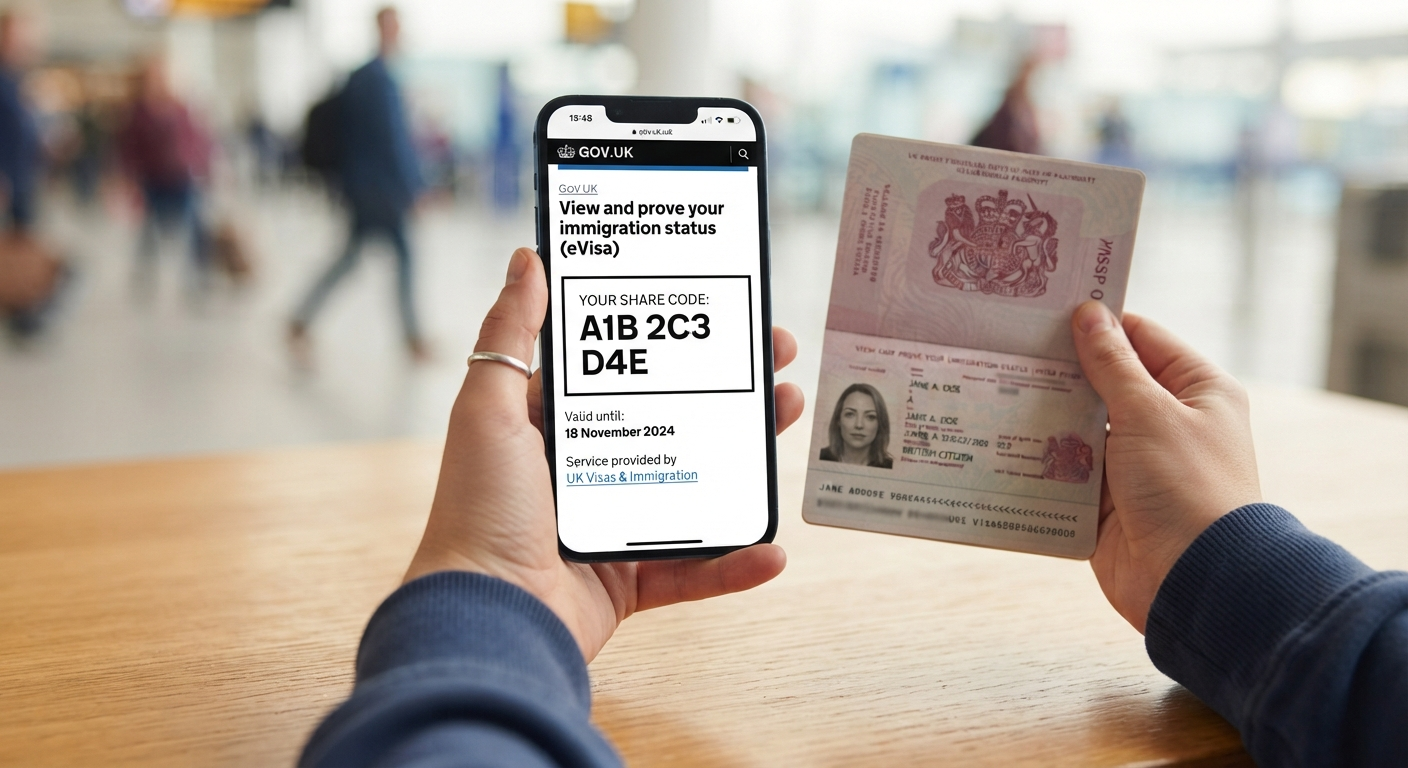
A share code allows an employer, landlord or other authorised person to check relevant information about your UK immigration status online. You normally do not need to hand over your physical immigration document when using the online service.
In 2026, understanding how eVisa share codes work is increasingly important because the UK immigration system has moved towards digital proof of immigration status.
This guide explains what a UK eVisa share code is, how to generate one, how long it lasts, what different share codes are used for, and what to do if your share code does not work.
Important: A share code is not your visa and does not itself give you immigration permission. It is a way of proving information about the immigration status recorded on your eVisa.
Quick Summary
| Question | Answer |
|---|---|
| What is an eVisa share code? | A code used to allow an authorised person to check relevant immigration-status information online |
| Who can use it? | Depending on the purpose, employers, landlords or other authorised parties |
| How long is a share code valid? | Generally 90 days |
| Can I use it more than once? | Yes, while it remains valid and for the purpose for which it was generated |
| Do I need to show my eVisa? | Usually, no |
| Do I need to provide my date of birth? | Yes, the person checking your status will generally need it |
| Can one share code be used for everything? | No. You need to select the correct purpose |
| Can I generate a new code? | Yes, you can generate a new share code when required |
| What if my eVisa is incorrect? | You should report the error to UKVI |
| What if I cannot access my eVisa? | You may need to recover your UKVI account or use another available status-checking route |
Key Takeaway
A UK eVisa share code is a digital way of proving your immigration status.
Your eVisa records information such as your identity, immigration status and relevant rights or restrictions. When you generate a share code, you select why you are sharing your status. The person checking the code can then access the information relevant to that purpose.
According to GOV.UK, a share code generally remains valid for 90 days and can be used multiple times before it expires. You can generate a new code whenever you need one.
What Is a UK eVisa?
An eVisa is a digital record of your identity and UK immigration status.
Instead of relying solely on a physical visa document, eligible individuals can access their immigration status through a UKVI account.
Your eVisa can show information about:
- Your identity
- Your immigration status
- Your permission to stay
- The conditions attached to your permission
- Whether you have the right to work
- Whether you have the right to rent
- Certain restrictions on your rights or access to services
GOV.UK explains that an eVisa shows your identity and immigration status, including information about rights such as working, renting or claiming benefits where applicable.
What Is an eVisa Share Code?
An eVisa share code is a temporary code that allows another person or organisation to check relevant information about your immigration status online.
For example, you may need to provide a share code to:
- A prospective employer
- Your existing employer
- A landlord
- A letting agent
- A carrier or border official in certain travel circumstances
- Another organisation that needs to verify your immigration status through the relevant Home Office service
You normally provide the share code and your date of birth.
The person checking your status uses the appropriate GOV.UK service to see the information they are authorised to access.
How Does a UK eVisa Share Code Work?
The process is relatively straightforward.
Step 1: Access your UKVI account
You need access to the UKVI account associated with your eVisa.
Depending on your circumstances, you may sign in using information connected with:
- Your passport
- National identity card
- Biometric Residence Card (BRC)
- Expired Biometric Residence Permit (BRP)
- UKVI customer number
You will also generally need access to the email address or mobile number connected to your UKVI account.
Step 2: View your eVisa
After signing in, check that the information shown on your eVisa is correct.
Pay particular attention to:
- Your name
- Date of birth
- Nationality
- Immigration status
- Permission dates
- Conditions attached to your status
If something is wrong, you should address the issue rather than simply assuming that the share code will correct it automatically.
Step 3: Select the reason for sharing
This is an important part of the process.
You should select the correct reason for generating the share code.
For example:
- Right to work
- Right to rent
- Travel or another permitted purpose
Different types of share codes are designed for different purposes.
Step 4: Generate your share code
The system generates a share code that you can give to the relevant person.
The code is generally valid for 90 days. You can use it multiple times during that period, provided it is being used for the appropriate purpose.
Step 5: Give the code to the relevant person
You normally provide:
- Your share code
- Your date of birth
The employer, landlord or other authorised person can then use the appropriate GOV.UK service to check your status.
What Are the Different Types of UK Share Codes?
One of the most common mistakes is assuming that every share code works for every purpose.
It does not.
You need to generate a share code for the appropriate purpose.
1. Right to Work Share Code
If you are starting a job or your employer needs to check your immigration status, you may need a right to work share code.
Your employer can use the Home Office online service to check information including:
- Whether you have the right to work
- The types of work you are permitted to undertake
- How long you can work in the UK
GOV.UK states that right-to-work share codes are generated specifically for this purpose. Employer guidance also states that work share codes begin with the letter W.
Example
Suppose you have permission under the Skilled Worker route.
Your prospective employer asks you to prove your right to work.
You would:
- Sign into your UKVI account.
- Select the option to prove your right to work.
- Generate the share code.
- Give the code and your date of birth to the employer.
- The employer completes the online check.
The employer can then see the relevant information concerning your right to work.
2. Right to Rent Share Code
If you are renting a property in England, you may need to prove your right to rent.
If you are not a British or Irish citizen, a share code can be one way of proving your right to rent.
The landlord or letting agent uses the relevant Home Office service to check your status.
Right-to-rent share codes are specifically generated for that purpose.
Government guidance states that right-to-rent share codes begin with the letter R. A landlord cannot use a work share code instead of the appropriate rent code.
Important geographical point
The statutory right-to-rent system applies to England.
You do not need to prove your right to rent in Wales, Scotland or Northern Ireland under this particular scheme.
3. Travel Share Code
There are also circumstances where an eVisa holder may need to use a share code when travelling.
GOV.UK explains that a travel share code can be generated before travel and is generally valid for 90 days and can be used more than once during that period.
However, having a share code does not mean you should ignore the requirement to keep your passport or travel-document information correctly linked to your UKVI account.
Before travelling, make sure your current passport or travel document details are correctly associated with your eVisa.
How Long Is an eVisa Share Code Valid?
A UK eVisa share code is generally valid for 90 days.
You can use it multiple times during its validity period for the purpose for which it was generated.
Once it expires, you can generate a new share code.
Example
You generate a work share code on 1 September.
It can generally be used during the following 90-day period.
If your employer needs to check your status again after the code expires, you can generate another code.
You do not normally need to wait for the old code to expire before generating a new one.
Can I Use the Same Share Code for Work and Rent?
No, you should not assume that you can.
Share codes are purpose-specific.
For example:
- A W code relates to right-to-work checks.
- An R code relates to right-to-rent checks.
- Other codes can be used for different purposes.
The Home Office guidance specifically explains that share codes can only be used for the purpose for which they were originally generated.
Therefore, if your landlord asks for a right-to-rent share code, do not simply send them the work code you previously generated.
Generate the correct code.
What Information Can Someone See With My Share Code?
The person checking your share code does not simply receive unlimited access to your entire immigration record.
The information they can see depends on the purpose for which the share code was generated.
GOV.UK states that the person using your share code will see some of your personal details and that you are informed what information will be visible when you generate the code.
This is one reason why selecting the correct purpose matters.
Do I Need to Give My Date of Birth?
Yes.
The person or organisation checking your status will generally need your date of birth alongside the share code.
For example, an employer may have:
- Your share code
- Your date of birth
They can then use the Home Office online service to conduct the relevant check.
What If My eVisa Is Wrong?
You should not ignore an error on your eVisa.
For example, your eVisa might show:
- An incorrect date of birth
- Incorrect immigration status
- Incorrect personal information
- An incorrect photograph
GOV.UK advises people to report errors with their eVisa, including situations where the eVisa is incorrect or where they can view it but cannot use it to generate a share code.
Why is this important?
Your share code is based on your digital immigration record.
If the underlying information is wrong, this can create problems when you are:
- Starting employment
- Renting accommodation
- Travelling
- Demonstrating your immigration status
It is therefore sensible to check your eVisa before you need to use it.
What If My Name or Nationality Has Changed?
If you have changed your:
- Name
- Nationality
- Photograph
you should update the relevant information on your UKVI account before generating a share code where necessary.
GOV.UK specifically advises updating account details where relevant before generating a share code.
What If My Share Code Does Not Work?
There can be several reasons why a share code does not work.
Possible issues include:
1. You generated the wrong type of code
For example, you gave a work share code to a landlord.
Solution: Generate the correct right-to-rent code.
2. The code has expired
Share codes generally expire after 90 days.
Solution: Generate a new code.
3. Your personal details are incorrect
There could be an error in your UKVI account or eVisa.
Solution: Check your eVisa and report an error where appropriate.
4. Your UKVI account cannot be accessed
You may have problems signing in because of an issue with your account or contact details.
Solution: Use the relevant UKVI account recovery or support service.
5. Your immigration status is not displaying correctly
This can be more serious.
If your eVisa does not correctly reflect your immigration permission, you should address the underlying problem rather than repeatedly generating new share codes.
What If I Cannot Access My eVisa?
If you cannot access your eVisa, first check whether you have completed the UKVI account setup process.
GOV.UK advises users who cannot view their eVisa to check that they have completed the necessary account setup. There are also routes for getting help recovering access to a UKVI account.
Depending on the circumstances, there may also be alternative ways of proving your right to work or right to rent.
For example, GOV.UK provides specific guidance for people who cannot use the online service.
Can an Employer Refuse My Job Because I Do Not Have a Share Code?
Not having a share code does not necessarily mean that you do not have the right to work.
The important issue is whether you can establish your right to work using an accepted Home Office checking process.
For many eVisa holders, the online share-code system is the normal way of demonstrating their right to work. However, GOV.UK also identifies alternative evidence or checking arrangements for certain categories of people.
If you genuinely have permission to work but the online system is showing incorrect information, it is important to address the problem rather than assume that your immigration permission has disappeared.
Can a Landlord Refuse Me Because I Do Not Have a Share Code?
Not necessarily.
For people subject to right-to-rent checks in England, a share code is one method of proving the relevant right.
GOV.UK states that eligible individuals who are not British or Irish citizens can use a share code or, in certain circumstances, original immigration documents.
However, the exact documents and checking procedure depend on your circumstances.
What Happens If My Visa Has Expired but I Have an Application Pending?
This is an important situation for many UK visa holders.
If you made an in-time application for further permission to stay before your existing permission expired, your existing rights may continue under the relevant legal framework, including Section 3C leave where its requirements are met.
Home Office employer guidance also recognises that the online checking service can support certain people with outstanding in-time applications.
This means that if your physical visa expiry date has passed, you should not automatically assume that you have no right to work.
The exact circumstances need to be checked carefully.
Does a Share Code Prove My Immigration Status Permanently?
No.
A share code is a temporary method of accessing relevant status information.
The code itself generally lasts 90 days.
Your underlying immigration status is separate from the share code.
For example, if you have valid Skilled Worker permission for several years, generating a share code does not reduce that permission to 90 days.
The 90-day period relates to the share code, not necessarily to your immigration permission.
Is an eVisa the Same as a Share Code?
No.
This distinction is important.
eVisa
Your eVisa is the digital record of your immigration status.
Share code
A share code is a temporary code that allows another person or organisation to access relevant information from that digital status record.
Think of it this way:
eVisa = your digital immigration record
Share code = a way of proving selected information from that record
What Should You Check Before Giving Someone a Share Code?
Before providing your code, check:
- Is the code for the correct purpose?
- Is your name correct?
- Is your date of birth correct?
- Is your immigration status correct?
- Are your permission dates correct?
- Are your work restrictions correct?
- Is your passport or travel document correctly linked where necessary?
- Has the code expired?
- Are you giving the code to the correct employer, landlord or organisation?
These simple checks can prevent avoidable problems.
Common UK eVisa Share Code Mistakes
Mistake 1: Sending a work code to a landlord
A work code is not automatically a rent code.
Better approach: Generate the correct share code for the purpose requested.
Mistake 2: Assuming the code lasts forever
Share codes generally expire after 90 days.
Better approach: Generate a new code when required.
Mistake 3: Ignoring an incorrect eVisa
An incorrect eVisa can cause problems when proving your status.
Better approach: Report errors to UKVI.
Mistake 4: Assuming a share code is your visa
A share code does not itself grant immigration permission.
Better approach: Treat the share code as a method of proving information about your existing status.
Mistake 5: Waiting until the last minute
If you are starting a job or moving into a new property, technical problems with your UKVI account can create unnecessary delays.
Better approach: Check your eVisa and account before you need to prove your status.
UK eVisa Share Code Checklist
Before using your share code, make sure:
-
You can access your UKVI account.
-
Your eVisa is visible.
-
Your personal details are correct.
-
Your immigration status is correct.
-
Your passport/travel document details are up to date.
-
You selected the correct reason for sharing.
-
You generated a new code if the previous one expired.
-
You provide your date of birth when required.
-
You give the code only to the relevant person or organisation.
-
You understand what information the recipient can access.
Example: Using an eVisa Share Code for a New Job
Imagine that Ahmed has a Skilled Worker visa and has accepted a new job with a UK employer.
The employer asks Ahmed to prove his right to work.
Ahmed:
- Signs into his UKVI account.
- Views his eVisa.
- Selects the right-to-work option.
- Generates a share code.
- Gives the share code and date of birth to his employer.
- The employer uses the Home Office online service.
- The employer checks Ahmed’s right to work and any relevant restrictions.
The important point is that Ahmed should generate a right-to-work share code, rather than simply providing a code generated for another purpose.
Example: Using a Share Code to Rent a Home
Suppose Maria has UK immigration permission and wants to rent a property in England.
The landlord asks her to prove her right to rent.
Maria:
- Accesses her UKVI account.
- Selects the option for proving her right to rent.
- Generates the appropriate share code.
- Gives the code and her date of birth to the landlord.
- The landlord uses the relevant Home Office checking service.
- The landlord receives the information needed for the right-to-rent check.
Right-to-rent share codes are purpose-specific and should not be confused with right-to-work codes.
What If My Share Code Shows the Wrong Immigration Status?
This can be concerning, particularly if you know that your immigration permission is valid.
Do not simply assume that the employer or landlord has made a mistake.
You should:
- Check your eVisa yourself.
- Confirm the immigration route shown.
- Check your permission dates.
- Check your personal information.
- Check whether your passport details are correctly linked.
- Report any error to UKVI.
- Keep evidence of your immigration permission and communications.
- Obtain professional immigration advice if the problem cannot be resolved.
GOV.UK specifically provides a process for reporting errors with eVisas.
Can I Generate a New Share Code?
Yes.
If you need another code, you can generate a new one through the relevant GOV.UK service.
This can be useful when:
- Your old code has expired.
- You need to prove your status for a different purpose.
- Your employer requests a new code.
- Your landlord requests a new code.
- You need a travel-related code.
- You want to make sure you have a current code.
GOV.UK confirms that you can get a new share code whenever you need one.
Does Changing My Share Code Change My Visa?
No.
Generating a new share code does not normally change your immigration permission.
The share code is simply a mechanism for allowing someone to check relevant information about your existing digital immigration status.
Your visa conditions and expiry date are determined by your immigration permission, not by the share code itself.
Why Are eVisa Share Codes Important in 2026?
The UK immigration system is increasingly based on digital immigration status.
For many people, the eVisa and online checking system are now central to proving their status.
This means visa holders should become familiar with:
- Their UKVI account
- Their eVisa
- Share codes
- Right-to-work checks
- Right-to-rent checks
- Travel-related status checks
- Reporting eVisa errors
- Updating passport and personal details
GOV.UK’s current eVisa guidance confirms that users can view their digital status and generate share codes to prove relevant immigration rights.
When Should You Get Professional Immigration Advice?
Most routine share-code problems can be dealt with through GOV.UK services.
However, professional advice may be appropriate if:
- Your eVisa shows the wrong immigration status.
- Your immigration permission appears to have disappeared.
- Your right to work is incorrectly showing as restricted.
- Your employer is refusing to accept your digital status.
- Your landlord is refusing an apparently valid right-to-rent check.
- Your visa has expired but you have a pending application.
- Your UKVI account contains incorrect information.
- You believe your immigration status has been incorrectly cancelled.
- You have received a Home Office decision affecting your immigration status.
- You are unsure whether you have continuing permission to work or remain in the UK.
A share-code problem can sometimes be a symptom of a wider immigration-status issue, so it is important to establish what the underlying record actually says.
Frequently Asked Questions
What is a UK eVisa share code?
A UK eVisa share code is a temporary code that allows an authorised person or organisation to check relevant information about your digital immigration status. It can be used for purposes such as proving your right to work or right to rent.
How long does an eVisa share code last?
A share code generally lasts for 90 days. It can normally be used multiple times during that period for the purpose for which it was generated.
Can I use the same share code for work and rent?
No. Share codes are purpose-specific. You should generate the appropriate code for the reason you are proving your immigration status.
What does a right-to-work share code start with?
Right-to-work share codes begin with the letter W.
What does a right-to-rent share code start with?
Right-to-rent share codes begin with the letter R.
Do I need to show my eVisa to my employer?
Generally, an eVisa holder can prove their right to work through the Home Office online service using a share code.
Do I need to give my date of birth with my share code?
Yes. The person checking your status will generally need your date of birth alongside the share code.
What should I do if my eVisa is incorrect?
You should report the error to UKVI. Errors can include incorrect personal details or immigration status, and GOV.UK also provides guidance for people who can view their eVisa but cannot generate a share code.
Can I get a new share code?
Yes. You can generate a new share code whenever you need one.
Is a share code the same as a visa?
No. Your eVisa is the digital record of your immigration status. A share code is a temporary way of allowing another person to check relevant information from that record.
Final Thoughts
The UK eVisa share code system is an important part of the UK’s increasingly digital immigration system.
For many visa holders, proving immigration status now means using an online eVisa rather than relying on a physical immigration document.
The key things to remember are:
- Your eVisa records your digital immigration status.
- A share code allows relevant information to be checked.
- Share codes are purpose-specific.
- Right-to-work and right-to-rent codes are different.
- Share codes generally expire after 90 days.
- You can generate a new code when required.
- Your date of birth is generally required for the check.
- You should check your eVisa for errors.
- Problems with a share code can sometimes indicate a wider immigration-status issue.
If your eVisa or share code does not accurately reflect your immigration permission, it is important to investigate the issue promptly rather than assuming that the problem is simply technical.


