
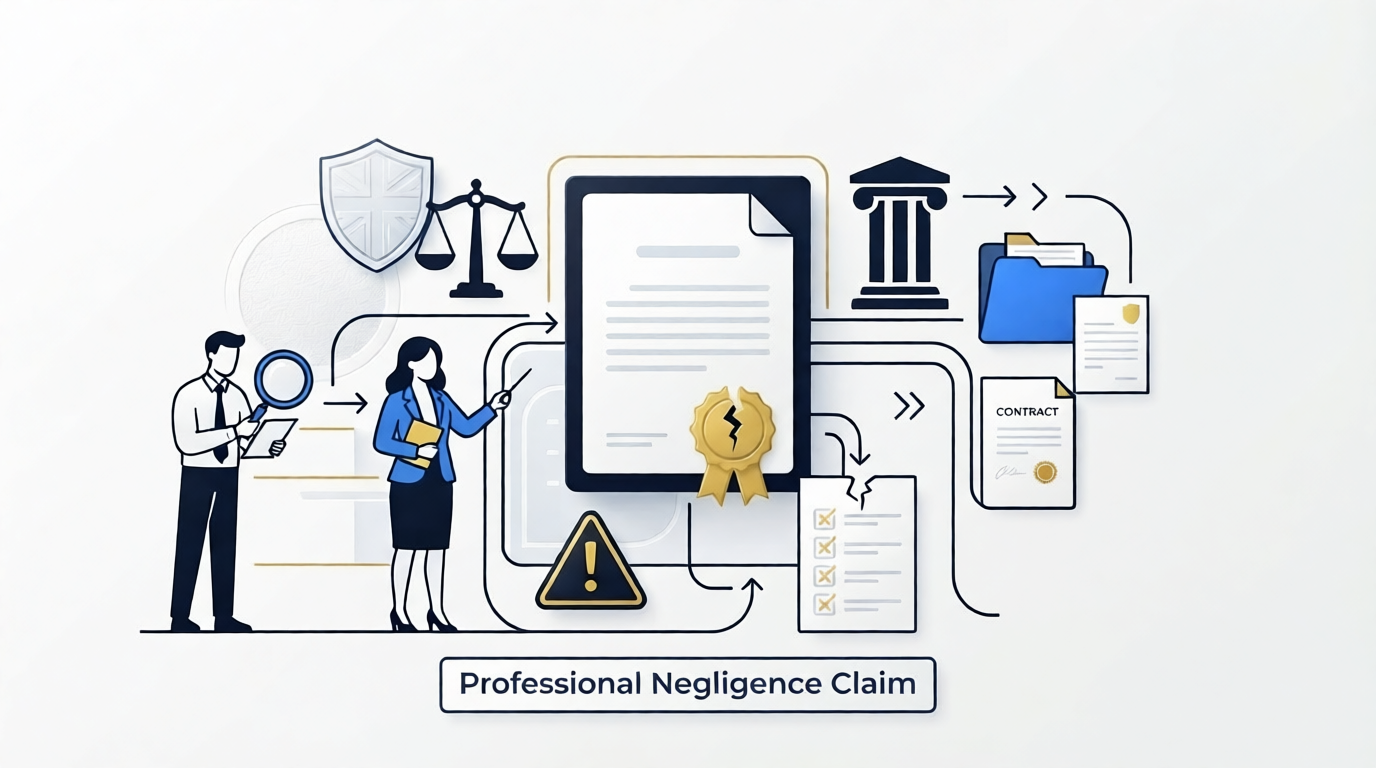
A professional negligence claim arises when a professional — a solicitor, accountant, financial adviser, surveyor, architect, or other adviser — fails to perform their duties to the standard reasonably expected of someone in their profession, and that failure causes you financial loss. If you’ve lost money because of bad professional advice, this guide explains what you need to prove, how long you have to act, what the claims process looks like, and how compensation is calculated in England and Wales.
What Counts as Professional Negligence?
Professional negligence occurs when a professional breaches the duty of care they owe you, and that breach causes you a measurable loss. It commonly arises in cases such as:
- Solicitors — missing a limitation deadline, giving incorrect legal advice, or drafting a defective contract or will
- Accountants — errors in tax advice, audit failures, or negligent financial statements
- Financial advisers — recommending unsuitable investments or failing to disclose risks
- Surveyors — undervaluing a property or missing significant defects during a survey
- Architects and engineers — design errors leading to costly building defects
- Insurance brokers — arranging inadequate or inappropriate cover
The Four Elements You Must Prove
To succeed in a professional negligence claim, you generally need to establish:
- Duty of care. The professional owed you a duty — usually straightforward to show where there was a contract or a clear professional relationship.
- Breach of duty. The professional’s conduct fell below the standard of a reasonably competent member of that profession. Courts typically apply the Bolam test — would a responsible body of professional opinion have supported what was done? — refined by Bolitho, which requires that opinion to withstand logical analysis.
- Causation. The breach must have actually caused your loss — not just contributed to a bad outcome that would have happened anyway.
- Loss. You must have suffered a quantifiable financial loss as a result.
Missing any one of these four elements will typically defeat a claim, which is why early, specific expert evidence matters so much.
Limitation Periods: How Long Do You Have?
Time limits are one of the most common reasons a strong professional negligence claim fails, so understanding them early is essential.
- Six years from the breach (contract) or from the date of actual loss (tort). This is the primary limitation period under the Limitation Act 1980. Crucially, in tort the clock generally starts when you first suffer real economic loss — often when you enter a flawed transaction — not when you first realise something has gone wrong.
- Three years from the “date of knowledge.” If the negligence wasn’t reasonably discoverable straight away, you have three years from when you knew, or ought reasonably to have known, of the loss and that it was caused by the professional’s fault.
- 15-year longstop. Regardless of when you discovered the problem, claims generally cannot be brought more than 15 years after the negligent act or omission — this cap applies even if the “date of knowledge” period would otherwise still be running.
Because the courts have taken an increasingly strict approach to when the limitation clock starts — a 2026 High Court ruling struck out a very substantial claim on exactly this point — it’s worth getting advice as soon as you suspect something has gone wrong, rather than waiting until the loss fully crystallises.
The Pre-Action Protocol: What Happens Before Court
Professional negligence claims in England and Wales are governed by a specific Pre-Action Protocol, which must generally be followed before proceedings are issued. The stages are:
- Preliminary notice (optional but common). A short letter identifying the parties and the general nature of the potential claim, prompting the professional to notify their professional indemnity insurers.
- Letter of claim. A detailed letter setting out the parties, a chronological summary of events, the specific allegations of negligence, the causal link to your loss, and the financial loss claimed, supported by documents.
- Letter of response. The professional typically has three months to investigate and respond, either admitting the claim in whole or part, denying it, or proposing settlement.
- Negotiation or mediation. Most professional negligence claims settle at this stage — through direct negotiation or mediation — rather than reaching trial.
- Court proceedings, if no resolution is reached, with a claim form and Particulars of Claim issued at the County Court or High Court depending on value and complexity.
Courts can penalise a party in costs for failing to properly engage with the protocol, even if that party ultimately wins.
How Long Does a Claim Take?
Timescales vary considerably with complexity:
| Route | Typical timeframe |
|---|---|
| Resolved through the pre-action protocol alone | 6–12 months |
| Resolved through mediation after protocol | 12–18 months |
| Proceeding to a County Court or High Court trial | 18–24 months+ |
The vast majority of claims settle before trial — a trial is very much the backstop, not the expected outcome.
What Compensation Can You Claim?
The aim of damages in professional negligence is to put you back in the financial position you would have been in had the negligence not occurred — not to punish the professional. Depending on the case, this can include:
- Direct financial loss — the actual monetary loss caused by the negligent advice or service
- Consequential losses — knock-on costs reasonably flowing from the original loss
- Loss of opportunity — where negligence deprived you of a chance you would likely have taken (for example, a property sale that fell through)
- Interest on the sum awarded, and legal costs, in many successful cases
Damages must not be too remote from the breach, and you’re expected to take reasonable steps to mitigate your losses once you become aware of the problem.
How Much Does It Cost to Bring a Claim?
- Court fees are calculated as a percentage of the value of your claim, capped at a maximum of £10,000 for the largest claims.
- Conditional fee agreements (CFAs), often called “no win, no fee” arrangements, are common in professional negligence work, particularly for stronger claims.
- After-the-event (ATE) insurance can cover your exposure to the other side’s costs if the claim is unsuccessful.
- Before-the-event (BTE) legal expenses insurance — sometimes included with home or business insurance policies — may already cover part of your legal costs; it’s worth checking existing policies first.
Most specialist firms will assess the merits of a claim, and discuss funding options, at an initial consultation before you commit to anything.
Steps to Take If You Suspect Professional Negligence
- Gather your documents — contracts, correspondence, advice given, invoices, and anything showing the loss you’ve suffered
- Get an early opinion from a specialist solicitor — professional negligence law is a distinct specialism, separate from the underlying area of advice
- Don’t approach the professional informally to “resolve it” without advice first — this can affect the strength of a future claim and the limitation clock
- Act quickly — given how strictly the courts interpret limitation periods, early advice protects your position even if you decide not to proceed immediately
- Consider whether other parties share responsibility — losses sometimes stem from more than one professional’s failure
Frequently Asked Questions
What’s the difference between professional negligence and a complaint to a regulator? A regulator (such as the SRA for solicitors or the FCA for financial advisers) can discipline a professional, but that process doesn’t compensate you directly. A professional negligence claim is a separate legal route specifically aimed at recovering your financial loss.
Do I need an expert witness? In most cases, yes. Expert evidence from someone in the same profession is usually needed to show that the standard of care fell below what a reasonably competent professional would have provided.
Can I claim if I signed off on the advice at the time? Potentially, yes. Signing off doesn’t automatically bar a claim, particularly where you weren’t given the information needed to make an informed decision, or the professional failed to flag risks you couldn’t reasonably have identified yourself.
What if the professional has since retired or the firm has closed? Professionals are generally required to hold professional indemnity insurance, which often continues to respond to claims made after a professional stops practising, depending on the type of cover in place.
Is mediation compulsory? No, but it’s strongly encouraged by the courts and is how a large proportion of professional negligence claims are ultimately resolved.
How much will my claim actually be worth? This depends entirely on your specific losses, evidenced with documents and, usually, expert input — a solicitor can give a realistic assessment only once they’ve reviewed your case in detail.
Conclusion
A professional negligence claim can recover significant losses caused by advice or services that fell short of a reasonably competent standard — but success depends on proving duty, breach, causation, and loss, and on acting within strict limitation deadlines that the courts continue to apply rigorously. Following the Pre-Action Protocol properly, gathering strong documentary and expert evidence early, and getting specialist advice as soon as you suspect something has gone wrong all significantly improve your chances of securing the compensation you’re entitled to. If you think a professional has let you down, don’t wait — speak to a solicitor who specialises in professional negligence to find out where you stand.
This article is for general information only and does not constitute legal advice. For guidance on your specific circumstances, consult a qualified professional negligence solicitor in England and Wales.


